BMW M8 GTE
Conoce todo sobre el BMW M8 GTE de iRacing, incluyendo especificaciones técnicas, consejos de frenado y más.
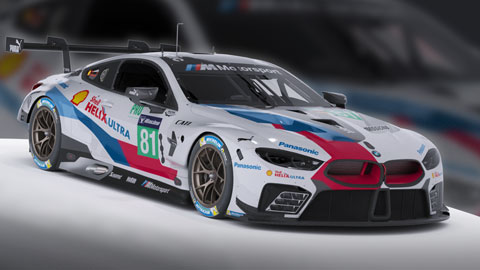
Image © iRacing.com Motorsport Simulations
Chassis
Power
Brakes
Bias Range
Adjustable
ABS
None
Downforce
Medium
Setup
Advanced
How the BMW M8 GTE Handles Braking
El BMW M8 GTE cuenta con un sistema de frenos sofisticado que incluye cilindros maestros ajustables y tres compuestos de pastillas de freno. Los cilindros maestros delantero y trasero se pueden dimensionar de forma independiente para cambiar el sesgo de freno y modificar el esfuerzo del pedal, mientras que los compuestos de pastilla van desde Bajo (menor fricción, menor riesgo de bloqueo) hasta Alto (mordida máxima, mayor riesgo de bloqueo). Lo más importante es que el sesgo de freno se puede ajustar sobre la marcha mediante controles en el habitáculo, permitiéndote afinar el balance de frenado a medida que el combustible se consume y las condiciones de pista evolucionan.
La configuración de frenos requiere equilibrar múltiples factores. Aumentar el camber delantero mejora el agarre en medio de curva pero reduce la tracción longitudinal al frenar, lo que requiere un ajuste del sesgo hacia atrás para compensar. El motor delantero y la considerable carga aerodinámica permiten al M8 usar un sesgo de freno bastante adelantado, pero necesitarás ajustarlo durante el stint conforme cambia la distribución de peso con el consumo de combustible.
Los amortiguadores también influyen en la estabilidad de frenado. Una compresión a baja velocidad más alta en el frente resiste el hundimiento al frenar, manteniendo consistencia aerodinámica pero potencialmente sacrificando agarre mecánico sobre baches. Para el frenado en curva, equilibra cuidadosamente el ángulo de rampa coast del diferencial: ángulos bajos aumentan el bloqueo y la estabilidad trasera pero pueden inducir subviraje en la entrada, mientras que ángulos altos permiten más rotación pero requieren modulación precisa del freno para evitar inestabilidad.
Deja de Adivinar, Empieza a Mejorar
Muchos pilotos frenan con toda su fuerza, pero los más rápidos modulan la presión, usan el freno para rotar el coche y salen lo más rápido posible. Entrena esa habilidad aquí.
Entrena Donde Sea, Cuando Sea
Entrenamiento desde el navegador compatible con cualquier pedal o controlador de carreras. Fanatec, Thrustmaster, Logitech, Simucube — sin instalación requerida.
Ejercicios Diseñados por Profesionales
Accede a ejercicios creados por sim racers profesionales como Suellio Almeida. Aprende los patrones exactos de frenado que usan los pilotos más rápidos.
Importa Telemetría del BMW M8 GTE
Suelta tu CSV de Garage61 y extrae datos de frenado de cada curva. Genera ejercicios personalizados basados en TU telemetría, no en patrones genéricos.
Sigue Tu Progreso
Visualiza historial de sesiones, tendencias de rendimiento y mejores puntuaciones. Observa cómo mejoras con el tiempo y mantente motivado para practicar.
And There's Much More
Improve your braking technique with this car and much more:
Create Custom Exercises
Build from templates, draw brake curves, or record with your pedal
Schedule Your Training
Plan practice sessions and track your consistency across weeks
Brake Master Ratings
Earn rankings and compete on leaderboards as you improve
Exercises & Progress Tracking
Practice exercises and track your progress completely free.
No install needed • Works in browser
3 Essential Setup Tips
Tip 1
Brake Bias
Brake bias controls front/rear brake force distribution. Start with 56-58% front for most cars. Engine placement matters: front-engine cars need more front bias (58-62%), mid-engine cars run balanced (54-58%), rear-engine cars need less (50-54%). Understeering under braking? Add 1-2% front bias. Rear feels loose in braking zones? Reduce front bias by 1-2%.
Tip 2
Know Your Car
Check if your car has ABS, traction control, or brake mapping. ABS allows later braking but can increase stopping distance—adjust activation threshold in setup. High-downforce cars brake later and harder at speed but lose grip quickly as downforce bleeds off. Low-downforce cars require earlier, progressive braking with more trail-braking to rotate.
Tip 3
Quick Fixes
Locking fronts frequently? Reduce front bias 1-2% or brake earlier with gradual pressure. Car won't turn in under braking? Increase front bias 1% and practice trail-braking deeper into corners. Rear unstable in braking zones? Reduce rear bias or use smoother pedal release.
Master Your Braking
Common questions about braking in this car. Practice these techniques in our free app.
What's the best brake bias for the BMW M8 GTE?
What's the best brake bias for the BMW M8 GTE?
Does the BMW M8 GTE have ABS or traction control?
Does the BMW M8 GTE have ABS or traction control?
Why do my brakes lock up in the BMW M8 GTE?
Why do my brakes lock up in the BMW M8 GTE?
How late can I brake in the BMW M8 GTE compared to similar cars?
How late can I brake in the BMW M8 GTE compared to similar cars?
How can I practice braking in the BMW M8 GTE?
How can I practice braking in the BMW M8 GTE?
Explora MásOther Coches
Coches similares que podrían interesarte
¿Listo para Dominar el BMW M8 GTE?
Pon en práctica este conocimiento con los ejercicios interactivos de frenado de Braking Lab. Importa tu telemetría y recibe retroalimentación personalizada.